A Word You’ve Heard, A Role Worth Understanding
The word deacon appears across Christian life in worship, church leadership, outreach, congregational care, and conversations about ministry. Even still, many Christians recognize the title before they can define the work with confidence.
A deacon is called to ministry shaped by service, spiritual maturity, and care for people inside the church and throughout the world. For some readers, the question “what is a deacon?” begins with curiosity. For others, the question becomes part of discernment after years of teaching, serving, mentoring, visiting, organizing ministries, or caring for people in need.
Understanding the role means looking at Scripture, present-day ministry, denominational differences, and the educational path that helps prepare someone for diaconal service.
The Meaning of “Deacon”: A Servant’s Calling
The word “deacon” comes from the Greek word diakonos, commonly translated as servant or minister. In the New Testament, the word carries the sense of faithful service offered for the sake of others and for the strengthening of the church.
Acts 6:1–7 gives one of the clearest biblical foundations. As the early church grew, widows were being overlooked in the daily distribution of food. The apostles appointed seven trusted believers to oversee that work so vulnerable people would receive faithful care.
Romans 16:1–2 identifies Phoebe as a deacon or servant of the church at Cenchreae, showing an early example of a woman serving in a recognized order of ministry. In 1 Timothy 3:8–13, Paul describes deacons as people of dignity, integrity, faithfulness, wisdom, and tested character.
The diaconate began with a real need in the church. People required care, the community required trustworthy leadership, and service became a visible expression of Christian faith.
What Does a Deacon Do Today?
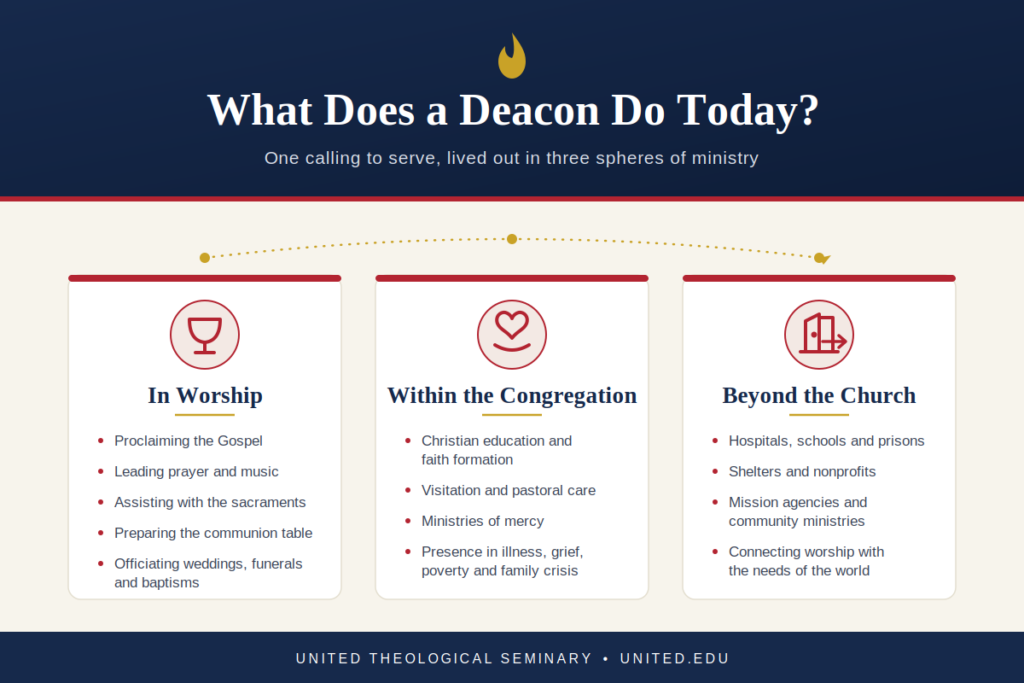
The role of a deacon today depends on denominational structure, though the work commonly includes worship, congregational care, teaching, outreach, and service beyond the church building.
In worship, deacons may proclaim the Gospel, lead prayers or music ministry, assist with sacraments, prepare the communion table, offer the dismissal, or help guide the congregation through shared worship. Some traditions authorize deacons to officiate weddings, funerals, baptisms, and other pastoral services.
Within the congregation, deacons often lead Christian education, faith formation, visitation, pastoral care, and ministries of mercy. Their work may place them close to people facing illness, grief, poverty, isolation, family crisis, or spiritual uncertainty. The ministry calls for theological grounding and practical compassion because people rarely bring simple needs to the church.
Beyond the congregation, deacons may serve in hospitals, schools, prisons, shelters, nonprofit organizations, mission agencies, counseling settings, and community ministries. Their work often connects the church’s worship with the wounds and needs of the world.
Deacon vs. Elder: How the Role Varies Across Traditions
The word “deacon” carries different responsibilities across Christian traditions, so context matters when defining the role.
In The United Methodist Church, the Order of Deacon became a permanent ordained order in 1996. United Methodist deacons are ordained clergy called to ministries of Word, Service, Compassion, and Justice. The Order of Elder is also ordained, with responsibilities centered on Word, Sacrament, Order, and Service.
Roman Catholic, Anglican, Episcopal, and Orthodox traditions recognize the diaconate as one of the major orders of ministry alongside priests and bishops. Some people remain permanent deacons for life. Others serve as transitional deacons before priestly ordination.
In many Baptist and congregational churches, deacons serve as elected lay leaders who support the pastor, care for church members, and help guide practical ministry needs. Presbyterian and Reformed churches often ordain deacons as lay officers who lead ministries of compassion, stewardship, and care.
Across these traditions, the structure changes but service remains the steady center of the calling.
Is God Calling You to Be a Deacon?
A call to become a deacon often develops through repeated patterns of service, prayer, responsibility, and affirmation from others. Many people begin noticing a persistent concern for those who are hurting, overlooked, poor, grieving, isolated, or disconnected from the church.
Some feel most alive when teaching, equipping, visiting, organizing outreach, or accompanying people through difficult seasons. Others feel drawn toward ministry that continues beyond Sunday worship into hospitals, schools, shelters, prisons, recovery programs, community nonprofits, and mission work. Through the work of a deacon, people can specialize in the area where they are most called to serve, building bridges between these focused areas of ministry and the wider church.
Discernment usually happens within the community. Pastors, mentors, professors, family members, ministry leaders, and trusted friends may notice gifts that the individual has not fully named. Their encouragement can help clarify whether the pull toward service may be part of a deeper vocation.
How to Become a Deacon: The Educational Path
For many traditions, the path to becoming a deacon includes theological education, spiritual formation, denominational discernment, and supervised ministry experience.
In The United Methodist Church, candidates for ordained diaconal ministry complete a master’s degree along with required graduate studies in Old Testament, New Testament, theology, church history, mission, evangelism, worship, and United Methodist doctrine, polity, and history. This preparation helps future deacons serve with biblical depth, theological clarity, and practical wisdom.
United Theological Seminary offers degree pathways for students discerning ordained ministry. The Master of Ministry is specifically designed to prepare students for the work of Deacon in The United Methodist Church, while United’s Master of Arts in Christian Ministries and Certificate in Service and Leadership both meet the educational requirements for preparation as a Deacon in the Global Methodist Church.
Students whose denomination requires the Master of Divinity, or who are still discerning between elder and deacon tracks, may decide to pursue the MDiv for broader ministerial preparation.
Following the Call to Serve
The question “what is a deacon?” may begin as a search for definition, then continue as part of prayer, service, conversation, and discernment. A calling often takes shape through recurring needs, repeated invitations, and a growing sense of responsibility for people God keeps placing before you.
United Theological Seminary has spent more than 150 years preparing faithful and fruitful Christian leaders for ministry in the church and the world. If the work of a deacon keeps returning to your attention, consider taking the next step toward discernment through theological education at United.