
TEACHING AND RESEARCH
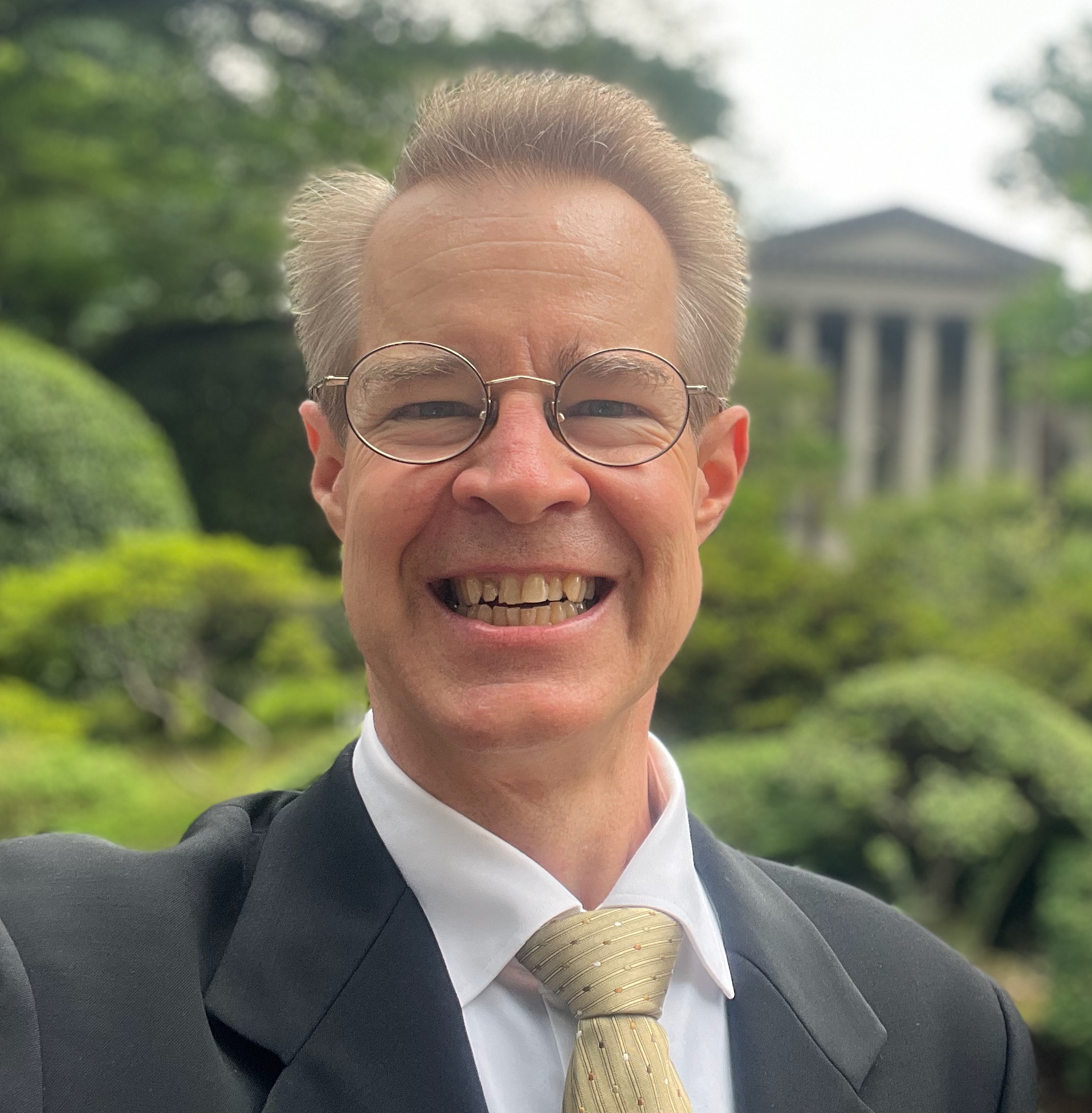
Dr. Shew’s work sits at the intersection of Methodist educational history, global mission, and the future of Christian higher education. His fields of specialization are modern Christian history, Christian education, and religious studies, with a particular focus on Christianity in Japan and on the Wesleyan educational movement as it has taken root across Asia.
At Aoyama Gakuin University in Tokyo he teaches Introduction to Christianity to about a thousand students a year, along with Christian Bioethics, the History of Aoyama Gakuin, and AI and Education. He is editor and co-author of the forthcoming revised edition of Salt of the Earth, Light of the World, the Japanese-language introduction to Christianity.
His sabbatical research during his year at United Theological Seminary examines the theological and historical resilience of Methodist educational institutions in times of social change: how Methodist educational and theological values have shaped institutional responses in the past, and how those same values might guide responses to present disruptions such as artificial intelligence, the climate crisis, and social polarization. The project draws on archival research in Methodist collections and on field visits to Methodist institutions in the United States and the Global South, with research travel planned to the Philippines, Malaysia, and India in 2027. It builds on over two decades of work with Methodist educational institutions in Japan and across Asia.
Dr. Shew has also been researching technological innovation in Christian education for over 20 years. For the last decade he’s been researching and leading conferences addressing issues of artificial intelligence, Christian education and character formation. He will present “Educating for Peace in the Age of AI: Cognitive Science, Moral Agency, and Digital Responsibility” at the European Methodist Lecture Program in October 2026.
EDUCATION
Ph.D., Fuller Theological Seminary, 2003. Dissertation: “History of Early Pentecostal Movement in Japan: The Roots and Development of the Pre-war Pentecostal Movement in Japan, 1907–1945.”
M.Div., Harvard Divinity School, 1997. Thesis: “Protestant Missions and Education in Japan.”
B.A., Earlham College, 1994, with study at Waseda University and Tohoku Gakuin University.
PUBLICATIONS
SELECTED BOOKS AND CHAPTERS:
Connecting Today and Tomorrow: The SDGs and the Message of the Bible (『今日と明日をつなぐもの:
Prayers of the University (『大学の祈り』). Tokyo: Kyodan Publishing, 2022. Co-author.
“The Founding of Christian Schools in Japan and the Role of Missionaries: An Examination of the Founding of Aoyama Gakuin and the Contribution of Dr. Goucher,” in The Mission and Challenges of the Christian University. Tokyo: Kyobunkwan, 2011.
Salt of the Earth, Light of the World: An Introduction to Christianity (『地の塩、世の光―
“Pentecostals in Twentieth Century Japan: A Fresh Look,” in Allan Anderson and Edmond Tang, eds., Asian and Pentecostal: The Changing Face of Christianity in Asia. Oxford: Regnum Books International, 2005.
SELECTED ARTICLES:
“AI and the Future of Christian Education: Balancing Innovation with Human-Centric Pedagogy.” Christianity and Culture 39 (2024): 133–145.
“Education for Tomorrow: On the Purpose of Christian Higher Education in an Age of Free Information.” Christianity and Culture 33 (2018).
“The Transformation of Higher Education in the Information Age and the Value of Christian Education.” Christianity and Culture 31 (2016): 71–86.
“Methodist Educational Values as Expressed through IAMSCU.” Christianity and Culture 30 (2015).
“Methodist Higher Education, Its Character and Practice: Aoyama Gakuin Learning and Growing from 800 Institutions Worldwide.” Christianity and Culture 29 (2014): 103–119.
“John Franklin Goucher and the Founding of Aoyama Gakuin.” Paichai University Journal, June 2010.
“Twenty-First Century Christianity and Globalization.” Bulletin of the Seigakuin University Research Institute 29 (2004): 101–118.
“A Forgotten History: Correcting the Historical Record of the Roots of Pentecostalism in Japan.” Asian Journal of Pentecostal Studies 5 (2002): 23–49.
PROFESSIONAL
Dr. Shew has served at Aoyama Gakuin University since 2004, where he is Professor in the College of Literature and University Chaplain (Director of Religious Affairs). Aoyama Gakuin, founded in 1874 by the Methodist Episcopal Church, is among the top private schools in Japan and continues to embrace its Methodist heritage and values today. He served as Vice-Chancellor of Aoyama Gakuin from 2019 to 2024 and as Dean of Religion from 2014 to 2018. He is also Deputy Director of the Aoyama Gakuin History Research Institute, Deputy Director of the Aoyama Gakuin Museum, and a Research Fellow of the Institute for Technological & Social Transformation.
Dr. Shew is an ordained elder in The United Methodist Church, West Ohio Conference. Before coming to Aoyama Gakuin he was a full-time lecturer at Seigakuin University and associate pastor of Omori Megumi Church in Tokyo (United Church of Christ in Japan), and he served congregations in Boston and Los Angeles. In 2012–2013 he was Scholar in Residence at the General Board of Higher Education and Ministry of The United Methodist Church.
He serves on the Board of Directors of APAMEI (the Asia-Pacific Association of Methodist Educational Institutions) and has been active for many years in IAMSCU (the International Association of Methodist Schools, Colleges and Universities) and ACUCA (the Association of Christian Universities and Colleges in Asia). In Japan he sits on the board of numerous Methodist organizations including Toyo Eiwa Jogakuin (schools), the Japan Christian Cultural Association, and the Bott Memorial Children’s Home.
PERSONAL
An American who has made Japan his home for almost three decades, Dr. Shew first came to the country as a high school exchange student and is a permanent resident of Japan. He and his wife live in Tokyo, where she serves as registrar at Christian Academy in Japan; they have three grown sons. He remains an active preacher with a particular interest in contemporary worship, and preaches dozens of times a year at various churches in both Japanese and English.